What is a pure water system? Key points of the 2-bed 3-tower mechanism and operation [Basic Knowledge]
Why is there a tower without resin between the cation tower and the anion tower? I will explain the reasons for the arrangement of two beds and three towers, as well as the key points for operation.
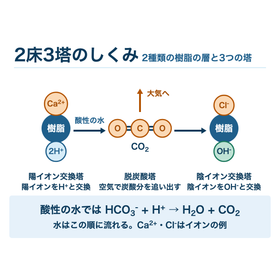
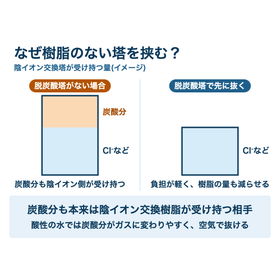
The pure water system is a device that creates pure water by removing ions dissolved in water. In the method using ion exchange resin, "2 beds and 3 towers" or mixed bed systems are common. Here, we will look at the meaning of the name "2 beds and 3 towers" and the reason for the order of the towers. ■ Meaning of the name "2 beds and 3 towers" "2 beds" refers to two types of resin layers for cations and anions, while "3 towers" refers to the following three towers. Water flows through them in this order: 1. Cation exchange tower: exchanges cations with hydrogen ions 2. Decarbonation tower: exposes water to air to expel carbonic acid 3. Anion exchange tower: exchanges anions such as chloride ions with hydroxide ions ■ Is there no resin in the middle tower?! In the first tower, calcium and other ions are exchanged with hydrogen ions, making the water acidic. In acidic water, dissolved carbonic acid tends to convert to gas. When air is blown in, it escapes into the atmosphere as carbon dioxide. ■ Why remove it first? Carbonic acid is originally the responsibility of the anion exchange resin. By expelling it with air first, the burden on the anion side is reduced, and the amount of resin packed in the tower can also be decreased. Please feel free to consult with us first.
- Company:トリイ
- Price:Other